
There is a specific kind of flat mix that no plugin fixes.
Everything is clean. The drums hit, the guitars are tight, the vocal sits on top, the low end is controlled. You did the work. And the whole thing sounds like it is happening on a poster. Two dimensions. Left, right, loud, quiet, and nothing behind anything else.
So you reach for reverb. A plate on the vocal, a room on the drums, maybe a long hall on the pad because it's pretty. You turn it up until you can hear it, then back it off until you can't, which is the rule everyone repeats, and the mix is now flat and wet instead of flat and dry.
The problem is that you are trying to add depth after the fact to a recording that never had any.
What depth actually is
Depth in a mix is your ear deciding how far away a sound source is. It makes that decision using three things, and only one of them is reverb.
The first is level. Farther things are quieter. You know this.
The second is high-frequency content. Air eats treble over distance. A guitar amp ten feet away has less sizzle than the same amp with a 57 an inch off the cone, and that difference is not something you dial in, it is physics doing it for you.
The third is the ratio of direct sound to reflected sound. Up close you hear the source. Farther back you hear the source plus the room arriving a few milliseconds later, and the farther you go, the more the room wins.
A reverb plugin only gives you the third one, and it gives it to you as a layer sitting behind a source that still has all the brightness and all the immediacy of something recorded two inches away. Your ear gets a contradiction: this thing is close, and also there is a room. It resolves that contradiction by hearing "close thing with an effect on it." Which is exactly what it is.
Record something far away
The fix is embarrassingly simple and almost nobody does it, because it requires committing to something at tracking.
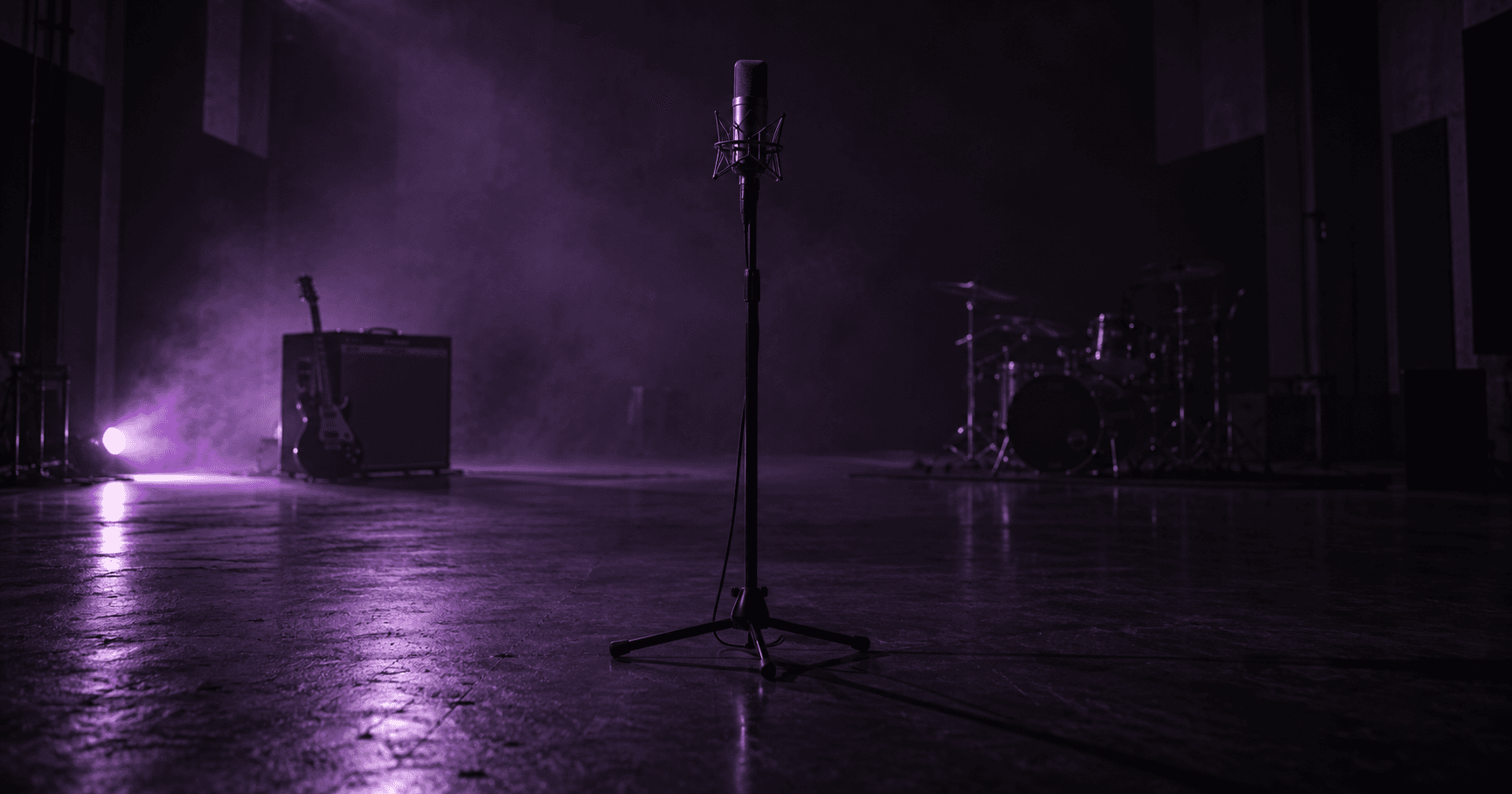
Put a mic across the room.
On drums, this is the oldest trick there is and it still works better than anything in the box. One mono condenser, six or eight feet back, waist height, pointed at the kit. Compress it hard. Blend it under your close mics until the kit stops being a collection of individual drums and starts being a thing happening in a space. Most of the drum sounds you love are mostly that mic.
On electric guitar, back a second mic off four or five feet and print it to its own track. It will sound thin and roomy alone. Underneath the close mic it does what no reverb does: it makes the amp exist somewhere.
On acoustic, this is the one that surprised me most. I spent years getting closer and closer to the guitar chasing detail, and ending up with a track that was all pick noise and proximity bass and no instrument. Back the mic off to two or three feet and the guitar starts sounding like a guitar in a room instead of a microphone's opinion of a guitar.
On vocals, you probably can't do this and shouldn't try for a lead. But a doubled background part sung deliberately a foot further back, blended low, will sit behind the lead in a way that no amount of send-level tweaking gets you.
If you can't record it, fake it correctly
Plenty of us are working in a small room with one decent mic and a neighbor. Fine. You can still build depth, you just have to do all three jobs instead of one.
Turn it down. Actually down, not three-tenths of a dB. Things in the back of a mix are meaningfully quieter than things in the front.
Take the top off. A shelf starting around 6 or 8k, pulled down a few dB, is doing the air-absorption job. It will feel wrong soloed. Depth always feels wrong soloed.
Then add the room, and add it as the last step, not the first.
And here is the one that matters most: use fewer reverbs. One room, on a bus, with multiple things feeding it at different send levels, will place those things at different distances in the same space. Five different reverbs on five different sources places five things in five different buildings, which your ear reads as no space at all.
The real cost of a flat mix
This is not just an aesthetic complaint. A mix with no depth has nowhere to put anything.
When everything is at the front, every new part you add is competing for the same square foot of space. That is why the arrangement starts feeling crowded at eight tracks instead of thirty, why the chorus gets louder without getting bigger, and why you keep carving EQ holes that don't seem to buy you anything.
Depth is not a polish step. It is an arrangement tool. A part placed in the back of the mix can do its job without taking anything from the parts in the front, which means you get to keep it instead of muting it at 1 a.m. and telling yourself the song is tighter without it.
Try this on the next thing you track
Next session, before you set up anything else, put a mic in the middle of the room and record every single thing you track that day to it. The amp, the acoustic, the shaker, whatever. One mic, one position, never moved.
You now have a room track of your entire song. Compress it, filter out everything under 200Hz, and bring it up underneath the mix until you feel it rather than hear it.
That is your record sounding like it happened somewhere. You cannot buy that, and you cannot add it in November for something you recorded in September.