
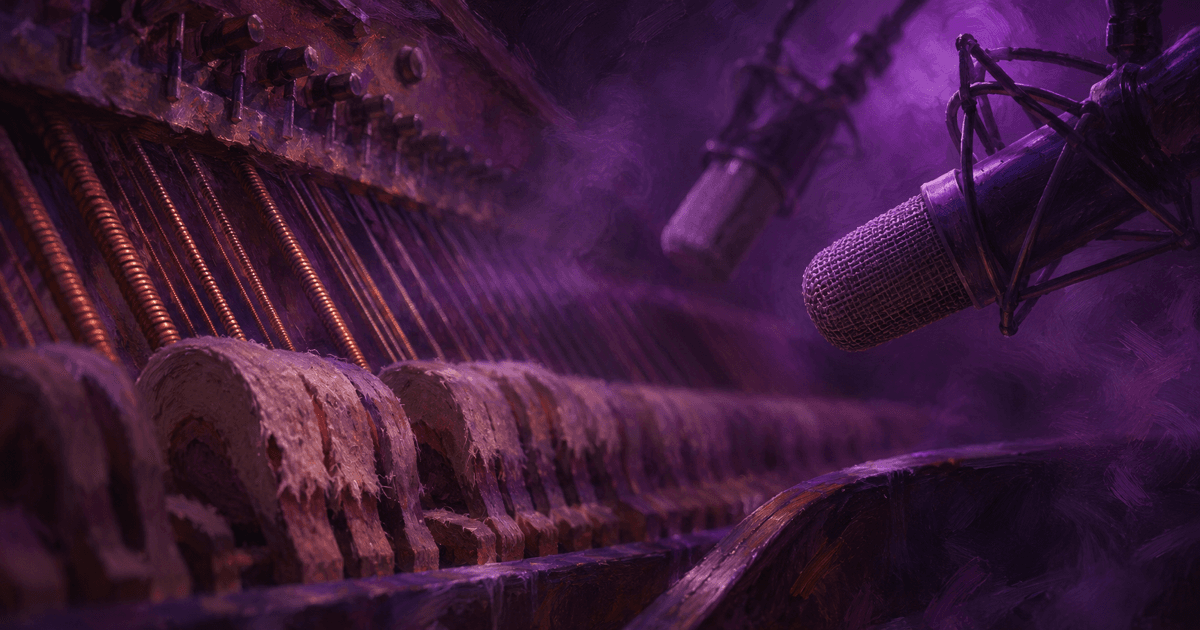
There's an old piano in my family, and I've started planning to sample it. I haven't recorded a note yet. All I have is a scope sheet, and the sheet has already changed how I think about the instrument.
The goal is a playable instrument built from that one piano, something I can use to score narrated stories instead of reaching for a library. It sounded like a simple project until I wrote the numbers down.
Every number is a decision
Sample every third semitone across 88 keys, which comes to about 30 notes. Five velocity layers per note. Two round robins per layer. That's 300 sustained samples, plus about 60 release samples and a handful of pedal and mechanical noises. Two or three sessions, after a one-octave pilot to lock in levels.
It reads like logistics. It's really a list of claims about what a piano is.
Five layers says a piano hit harder isn't just louder. It's brighter, because a harder strike brings out more of the upper partials. A volume knob can't fake that, so the layers have to capture it. Five is my bet on how many tones it takes before the jumps between them stop showing.
Two round robins says the same key struck twice is never the same sound. Without alternates, fast repeated notes turn into a machine gun. Two is close to the floor.
Every third semitone means each sample stretches across three keys, pitched up or down by one. That's fine across most of the keyboard. It's least safe where the piano changes construction, like the point where copper-wound bass strings give way to plain steel. That spot differs from one piano to the next, so an even grid could smear it. I'll have to find it on this piano by ear and build the map around it.
Sixty release samples says letting go of a key is a sound too. The damper lands on the strings and the note stops with a small soft thud. Except at the very top of the keyboard, where most pianos have no dampers at all and the notes just ring. The script has to know that. I've listened to pianos my whole life and never once thought about it.
The part I can't buy
Here's the question I had to answer before any of the rest mattered: why do this at all?
There are libraries built from concert grands in beautiful rooms, recorded by people with far better microphones and far more experience than I have. I won't beat them on anything they're graded on. If I record my family's piano and edit it until it's clean, I'll have spent months building a worse version of something I could buy.
So the only reason to do this is the material a commercial library would clean out. The thump of the pedal. The scrape of the action. Unisons that have drifted slightly apart over the decades. The room it lives in. A concert grand can't give me any of that, because it isn't this piano.
The record I keep coming back to is Nils Frahm's Felt. He put a layer of felt in front of the strings so he could play at night without bothering the neighbors, and he set the mics so deep in the piano they nearly touched the strings. They caught the action, the creaks, his breathing. Most producers would work hard to hide those sounds. On that record they're a big part of why it feels like being in the room.
That's the sound I want under a narrator. Quiet, close, a physical object in a real place. A voice telling a story at low volume leaves a lot of space, and in that space the small noises are most of what the listener gets from the piano.
So the scope changes. The noise layer isn't a bonus at the end of the project. It's the point, and it gets recorded with the same care as the notes.
What the sheet can't answer
Three decisions won't get settled on paper.
Whether to tune it. A freshly tuned piano plays well with everything else in a session. An untuned one is the piano as it actually sounds. If the whole instrument has sagged flat, I can fix that in the sampler, but beating unisons are baked into the recording. My current lean is to get it close enough to work with other instruments and leave the rest of its age alone. The pilot octave will tell me whether that holds.
Which engine to build in. Kontakt is the obvious home. It's also made by a company that entered preliminary insolvency in January and agreed to a sale to inMusic in May. I don't expect Kontakt to vanish, but this is a one-time recording of one specific instrument, and it should outlive any sampler. So the files get a strict naming convention, the mapping gets scripted, and the same samples should load in Decent Sampler (free) or HISE (open source) without redoing the work. The engine is a choice I can change later. The recordings are the asset.
My own hands. Guitar is my first instrument, and I'm still brushing up on keys. The whole plan assumes I can hit 300 notes at five consistent dynamic levels, by hand, across several sessions. Pro sample teams use robots for this kind of thing for a reason. I can match levels afterward, but the tone of a strike stays whatever it was when the hammer hit the string. If my medium-loud on Saturday is brighter than my medium-loud on Sunday, I'll hear it in the mapped instrument.
That's what the pilot is for. One octave, every layer, then play it back and look for the seams before committing to the rest of the keyboard.
What I've got so far
No samples, no script, no instrument. What I have is a list of questions I never asked about an instrument I thought I understood. Where does the bass change character? How many distinct tones does this piano actually have between soft and loud? What does it do when I let go?
I could spend a long time with a keyboard and never ask those. Planning the capture forced them, and I'm wondering what the same exercise would do for my guitar.
The first session is one octave in a quiet house. The takes I'm most curious about are the ones a library editor would throw away.