
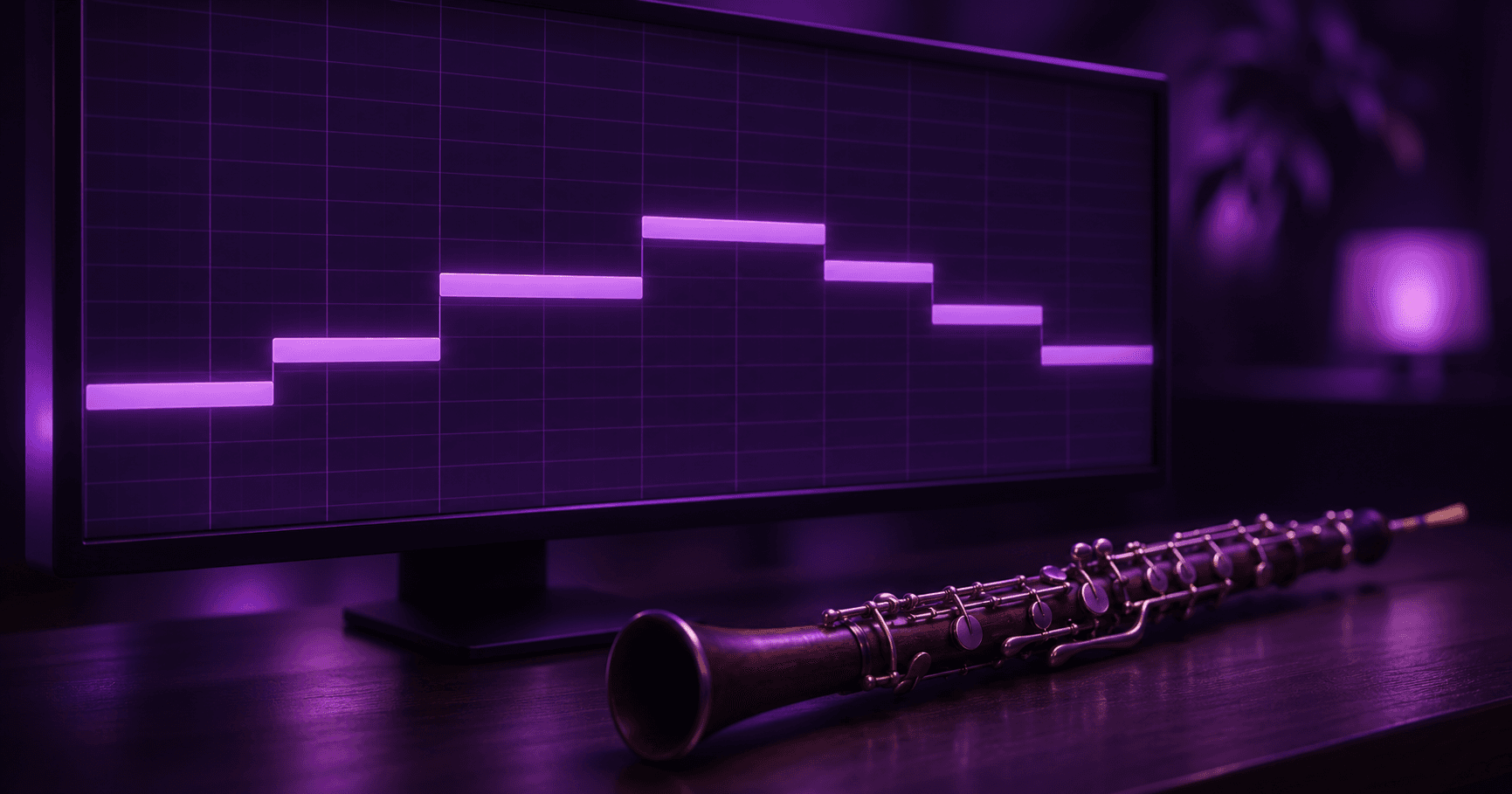
I bought a new orchestral instrument this month, and the first thing it did was take away my favorite way of working.
It's called Instrument X. It's a modeled instrument, not a sample library: woodwinds, strings, brass and the rest, generated from a model of how the instrument behaves instead of from recordings of every note. That part gets most of the attention. The part that changed my week is smaller. It doesn't play live.
I can't put my hands on the keyboard and noodle until something sounds right. Notes go into its editor (imported, recorded, or drawn in), and then it renders the audio ahead of time. Play, listen, adjust, render, listen again. It works more like handing a chart to a player than like playing.
I'm a guitarist first. Almost everything I've ever made started with my hands finding something before my head knew what it was. So this felt like a step backward. A few days in, I think it's the most useful thing about the instrument.
Legato is written, not played
The first rule I ran into is simple. For two notes to slur together, they have to touch exactly. Leave a gap and the slur breaks. Let them overlap and the slur breaks too.
With a sample library, legato is usually a mode. I'd hold a keyswitch or a pedal, play overlapping notes, and the library figures it out. My sloppiness is absorbed by the patch.
Here, the phrase is in the note lengths themselves. Where one note ends and the next begins is the whole instruction. The forums are full of people tripping on this, especially anyone importing MIDI they played in by hand, because human timing is never exactly flush. There's even a built-in script that closes the small gaps.
What stuck with me is that this isn't a software quirk so much as a picture of what a phrase is. A wind player slurring two notes isn't doing anything to the notes. They're choosing not to stop the air. A gap is a breath. An overlap doesn't exist on an oboe at all. The instrument is asking me to decide, note by note, where the player breathes.
On guitar I make that decision with my fretting hand without ever naming it. Hammer-on or pick the next note, let it ring or mute it. I've never had to write it down, because I was the player.
The short-note floor
The second rule: notes shorter than about a 32nd at 120 BPM fall apart. They come out garbled and land early. Users who've spent time with it say to stay at a 16th or longer.
My first reaction was that this is a limit of the model. Probably it is. It's also roughly a limit of real players. Fast repeated notes on a solo woodwind are hard, and players who can do them don't do them for bars at a time. Writing at the speed my fingers can move on a MIDI controller has always been one of the easiest ways to make a mockup sound fake. Here the instrument just refuses.
Trills are similar. The built-in trill articulation isn't good, and the common advice is to write the trill out as real slurred notes. Which means deciding how fast it goes, whether it speeds up, and where it stops. Those are the musical choices the articulation button was hiding.
Dynamics don't come for free
The dynamics lane has less range than I expected. People who use it daily add gain curves on top, a few dB up or down, to get a real difference between soft and loud.
That one taught me something about my own habits. When I program strings with samples, I ride the mod wheel and the library does the rest: louder is brighter, softer is darker, all baked in. I've never really shaped a crescendo. I've waved at one. Drawing it means deciding where the phrase peaks, and it's almost never where I'd have guessed.
What it's good at, and what it isn't
From the people who've spent the most hours with it, the agreement is fairly consistent. Solo instruments are where it shines: oboe, flute, bassoon, solo violin, solo cello, horn, tenor sax. Big string sections are weaker. The ensemble setting starts to phase once it's stretched past a few players, and the workaround is building a section out of several separate solo tracks with different timing and vibrato. That's basically how a real section works: a group of individuals who don't quite agree.
That fits what I want it for. The stories with sound I'm working toward are intimate. One narrator, a quiet bed of music, maybe a single woodwind line carrying the melody. I don't need a hundred players. I need one oboe that sounds like someone is holding it.
Writing like an arranger
Here's what I think the week actually changed. With a playable instrument I can audition ideas at the speed of my hands, and that's a gift when I'm writing. It's also how I've avoided learning orchestration properly. If it sounded okay when I played it, I moved on, and I never had to know why a line worked on a cello and not on a flute.
Rendering offline breaks that loop. Every note is a decision I make before I hear it. Every slur, every breath, every crescendo has to be written. That's slower, and it's exactly the skill I've been missing. Arrangers have always worked this way. They write it down and hand it to someone else.
My plan is to keep the two jobs separate. The melody and harmony still start on guitar or piano, where my hands lead. Then I write the parts, slowly, for players who only do what's on the page. If the oboe line doesn't breathe, that's on me now. The patch isn't going to fix it.