
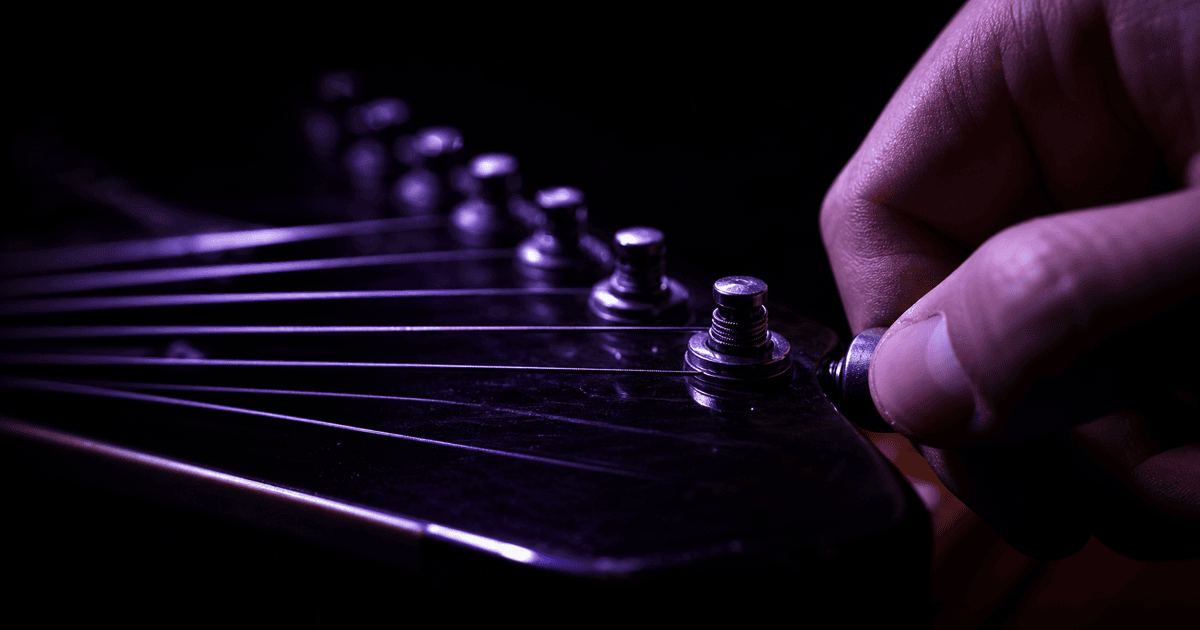
Here's a thing I keep relearning. When I'm stuck writing, the problem is almost never me. It's the guitar being in standard.
Standard tuning is a set of hands. After enough years your fingers have worn grooves into it. You reach for a chord and you already know where it goes, which means you already know how it sounds, which means the song you're about to write is one you've basically written before. The tuning is doing the composing and you're just signing off on it.
So I drop it. Not for the tone. For the amnesia.
Your hands stop knowing where they are
Put the guitar in something you don't have memorized (open D, DADGAD, drop the whole thing a step and a half) and you become a beginner again for about twenty minutes. That's the whole point. You can't reach for the shape you always reach for because your fingers don't know where it lives anymore. You have to look. You have to listen to find the chord instead of muscle-memory-ing into it.
And when you're listening instead of remembering, you write different melodies. You write different voicings because the easy ones aren't easy. Notes ring open that never ring open in standard, and those open strings drone under everything and suggest a whole harmonic direction you'd never have chosen on purpose.
I've written more usable ideas in the first hour of a new tuning than in a week of standard. Not because I got better. Because I got lost, and being lost is where the new stuff is.
It's not an effect, it's a constraint
People think of alt tunings as a tone move: the big open ringing thing, the folk-y drone, the heavy detuned chug. And sure, those are real. But I'm not chasing a sound. I'm chasing a limitation.
A new tuning is a smaller room. Fewer shapes work, so the ones that do carry more weight. You commit to a couple of anchor chords and you build the whole idea around them because you literally can't sprawl. Constraint is the oldest songwriting trick there is, and re-tuning is the fastest way to impose one without pretending you have less gear or less time than you do.
Open tunings are especially good for this because they hand you a chord for free: strum open and you're already somewhere. The song starts before you've decided anything. Then a single finger moved one fret over becomes an event, because everything around it is ringing open and unchanged. You get maximum consequence from minimum motion. That's a great place to write from.
It changes what lands in the mix, too
This part matters if you're the one producing as well as writing, which most of us are now.
A part written in an alt tuning sits differently in a track than the same chords voiced in standard. The open strings give you these low, sustaining drones that occupy a register a capo-ed or barre-chord version never touches. That drone can be your bass movement, or it can fight your bass, so you find out early and you arrange around it. Either way you're making a decision the standard-tuning version would have let you skip.
I've had detuned rhythm parts where the low string was basically doing pad duty. No synth needed. The guitar was already holding the floor of the track. You don't get that gift in standard without deliberately building it, and by then you're arranging instead of discovering.
How I actually use it
I don't keep six guitars in six tunings. I have one I leave in standard and one I move around depending on what I'm chasing that week.
When a song won't come, I don't push harder on the blank page. I retune. DADGAD when I want something modal and open that doesn't commit to major or minor. Open D or open G when I want it to ring and feel old. Drop the whole guitar down when I want the writing itself to feel heavier and slower, not just the recorded tone.
Then I write badly on purpose for a while. I let my hands fumble. I record everything, even the wrong turns, because in a tuning I don't know, the "mistakes" are the discoveries: I fingered a shape I didn't intend and it was better than what I meant to play.
The trap to avoid: don't retune, write the part, then immediately transcribe it back into standard "so it's easier to play live." The minute you do that, you flatten it back into the shapes your hands already knew, and you lose exactly the thing the tuning gave you. Keep it awkward. Learn the awkward version. The awkwardness is the fingerprint.
The point isn't novelty
I'm not saying chase weird tunings to sound weird. Half of what I write in an alt tuning ends up sounding perfectly normal, a straight-ahead song that just happens to have a voicing or a drone in it you can't quite place, and can't quite forget.
That's the real payoff. Not exotic. Unfamiliar to yourself. When you can't autopilot, you make choices, and choices are what make a song sound like a person decided it instead of a pattern producing it.
Next time you sit down and nothing comes, don't blame the well. Blame the map. Your fingers know one map too well. Fold it up, put the guitar somewhere it's never been, and go get lost for an hour.
Something's in there. It's just not where you always look.