
I spent an hour last week deciding whether a rhythm guitar should have a little more reverb.
Not recording it. Not writing the part. Just moving a wet/dry knob back and forth, listening on repeat, unable to land the plane. The take was already good. The tone was already good. I was stuck because I could keep changing it forever, and forever is a terrible place to make a decision from.
This is the quiet problem with the way most of us work now. Everything is recallable. Every plugin stays open, every setting stays editable, every choice stays a choice right up until the day you bounce the master. That sounds like freedom. In practice it is a room with no walls, and you can wander in a room with no walls for a very long time without getting anywhere.
Infinite recall is not free
The pitch of a modern DAW is that nothing is ever committed. You can print a guitar through an amp sim and change the amp next week. You can track vocals dry and decide the reverb in the mix. You can leave the drum tuning, the tape saturation, the delay throws, all of it, floating and adjustable.
And you pay for that. You pay in decisions you never make. A part you have not committed to is a part you are still auditioning, and a song full of auditioning parts never quite becomes a song. It stays a collection of options.
There is also a real sonic cost. When you commit a guitar to a specific amp and a specific room, the rest of the arrangement gets built around that sound. The bass finds its pocket against that tone. The vocal sits where it sits because the guitar is already taking up that space. When everything stays flexible, nothing gets to be the anchor, and you end up with a mix full of parts that are all politely waiting for each other to commit first.
What committing actually does
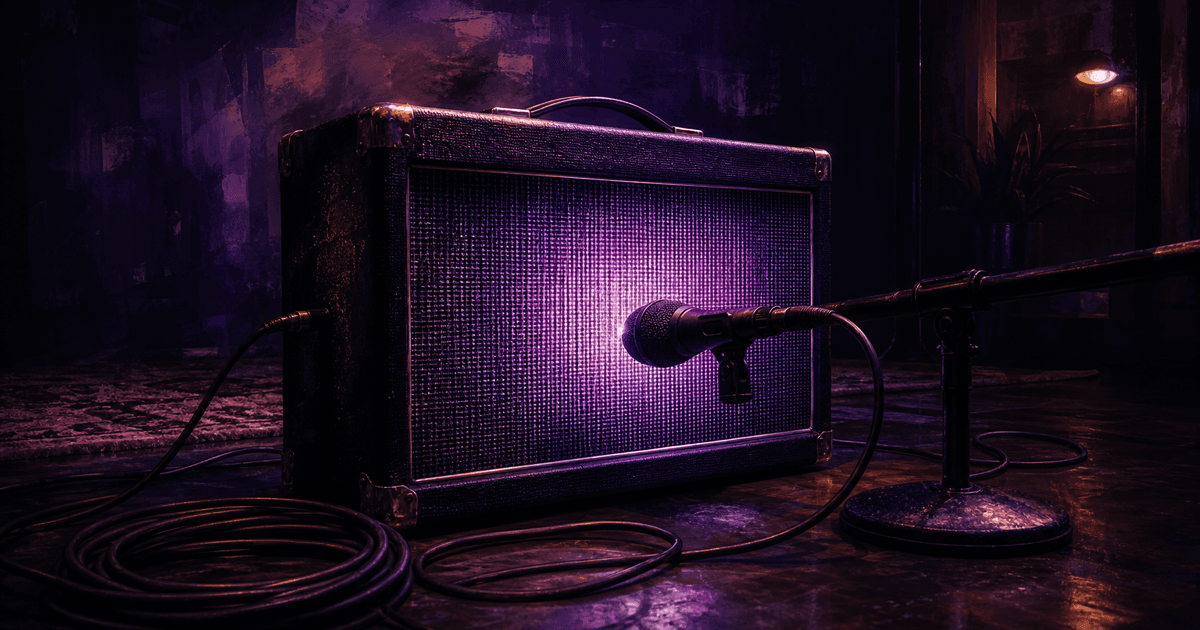
I started printing more sounds this year. Guitar through the amp, mic in the room, into the track as audio. Not a re-amp-later DI. The actual sound.
The first thing that happens is you get better at the front end. If the tone is going to tape, you fix it at the amp. You move the mic. You change the pickup. You turn down the gain because you can hear it is too much now, not in three weeks when it is buried under four other tracks and you have stopped being able to hear anything clearly at all.
The second thing that happens is the song moves forward. A committed part is a finished part. It is done. You are not going to open it again, so your brain stops holding a background process open for it. Multiply that across a session and the difference is enormous. I get more done in an afternoon of committed tracking than in a week of keeping everything open.
The third thing is harder to describe. Committed records sound like someone made them. When you hear a guitar tone that is a little too dark, or a vocal that is drenched in more reverb than the textbook would allow, you are hearing a decision. A person stood in a room and said yes, that, and closed the door. That yes is most of what we mean when we say a record has character.
You are allowed to be wrong
The fear, of course, is committing to the wrong thing. Printing a tone you hate and being stuck with it.
Here is what I have learned. You are almost never as wrong as you are afraid you are. The take you committed to at 11pm usually sounds fine in the morning. And on the rare occasion it does not, you re-record it. Recording it again is cheap. It is one part. What is expensive is the version of you that never commits to anything and carries forty open questions into the mix, because that version never finishes.
Give yourself an escape hatch if you need one. Print the committed guitar and keep a clean DI running alongside it, muted, in case the whole idea collapses. But treat the DI like a fire extinguisher, not a lifestyle. If you find yourself reaching for it every session, you are not committing, you are just delaying the same decision to a worse time.
A working rule
Try this on the next thing you track. Before you hit record, decide what the sound is. Get the tone right at the source, in the room, with your hands. Then print it as audio and, this is the actual discipline, close the plugins. Do not leave them open. Do not leave yourself the option.
Do it with a guitar first, because guitars are the easiest place to feel the payoff. A committed guitar tone forces the arrangement to organize itself around a real sound instead of a placeholder. Then try it with a vocal. Print a little of the reverb. Print the compression that makes the performance feel the way it felt when they sang it.
You will make some choices you would not make again. That is fine. Those choices are the record. The alternative is not a better record, it is a longer wait for one that sounds like it was assembled by committee, because in a way it was, and the committee was just you, at different hours, never agreeing with yourself.
Land the plane. Print it and move on. The song is waiting on the other side of the decision you keep refusing to make.